


 Be Inspired
 Roller Fabrics
 Vertical Fabrics
 Roman Fabrics





Blog Post
How to Open and Close Venetian Blinds: Common Mistakes to Avoid
Nov
Why Correctly Operating Venetian Blinds Matters
Venetian blinds are among the most versatile and practical window coverings available for modern homes, offices and commercial premises. Their adjustable horizontal slats provide excellent control over natural daylight, privacy and the atmosphere of any room. Whether you have aluminium Venetian blinds, faux wood Venetian blinds or traditional solid wood Venetian blinds, understanding how to operate them correctly is essential to maintaining their appearance and extending their working life.
However, one of the most common problems experienced by Venetian blind owners is surprisingly simple: using the wrong cord, pulling in the wrong direction or attempting to raise or lower the blind while the slats are incorrectly positioned.
These seemingly minor mistakes can place unnecessary strain on the internal mechanisms, damage the lifting cords, affect the alignment of the slats and potentially cause the operating mechanism to malfunction.
At Grays Window Blinds, we believe that purchasing quality window blinds should also mean understanding how to use, maintain and care for them properly. Our aim is to provide customers throughout Dublin and the Republic of Ireland with useful information that helps them make informed decisions when purchasing made-to-measure window blinds online.
In this comprehensive guide, we explain how to open and close Venetian blinds correctly, identify the most common operating mistakes, understand how the different cords and mechanisms work and prevent unnecessary damage.
Whether you are considering new Venetian blinds for your home or simply want to get more from the blinds you already own, this guide will help you operate them with confidence.

Understanding How Venetian Blinds Work
Before operating Venetian blinds, it is important to understand the different components responsible for their movement.
Although Venetian blinds are available in different materials, colours, widths and operating configurations, most traditional cord-operated designs incorporate three principal components.
1. The lifting mechanism
The lifting mechanism controls the overall height of the blind.
Depending on the design, lifting cords run through the headrail and down through openings or routed sections of the horizontal slats. These cords work together to raise and lower the blind evenly.
When operated correctly, the lifting mechanism allows the blind to be positioned at the required height.
2. The slat tilting mechanism
The tilting mechanism controls the angle of the horizontal slats.
Depending on the model, this is operated using a separate tilting wand, a cord-operated mechanism or another manufacturer-specific control.
Tilting allows you to adjust incoming sunlight without necessarily raising the blind.
For example, you can angle the slats upwards to reduce direct sunlight, adjust them downwards for additional privacy or position them horizontally to allow more natural daylight into the room.
3. The headrail and internal components
The headrail houses the operating mechanism and supports the blind.
Inside the headrail are components such as cord locks, drums, ladders, tilt mechanisms and other fittings, depending on the particular Venetian blind system.
These components work together to ensure that the blind raises evenly and that the slats rotate consistently.
Understanding these three components makes it considerably easier to identify which control should be used for each operation.
How to Open Venetian Blinds Correctly
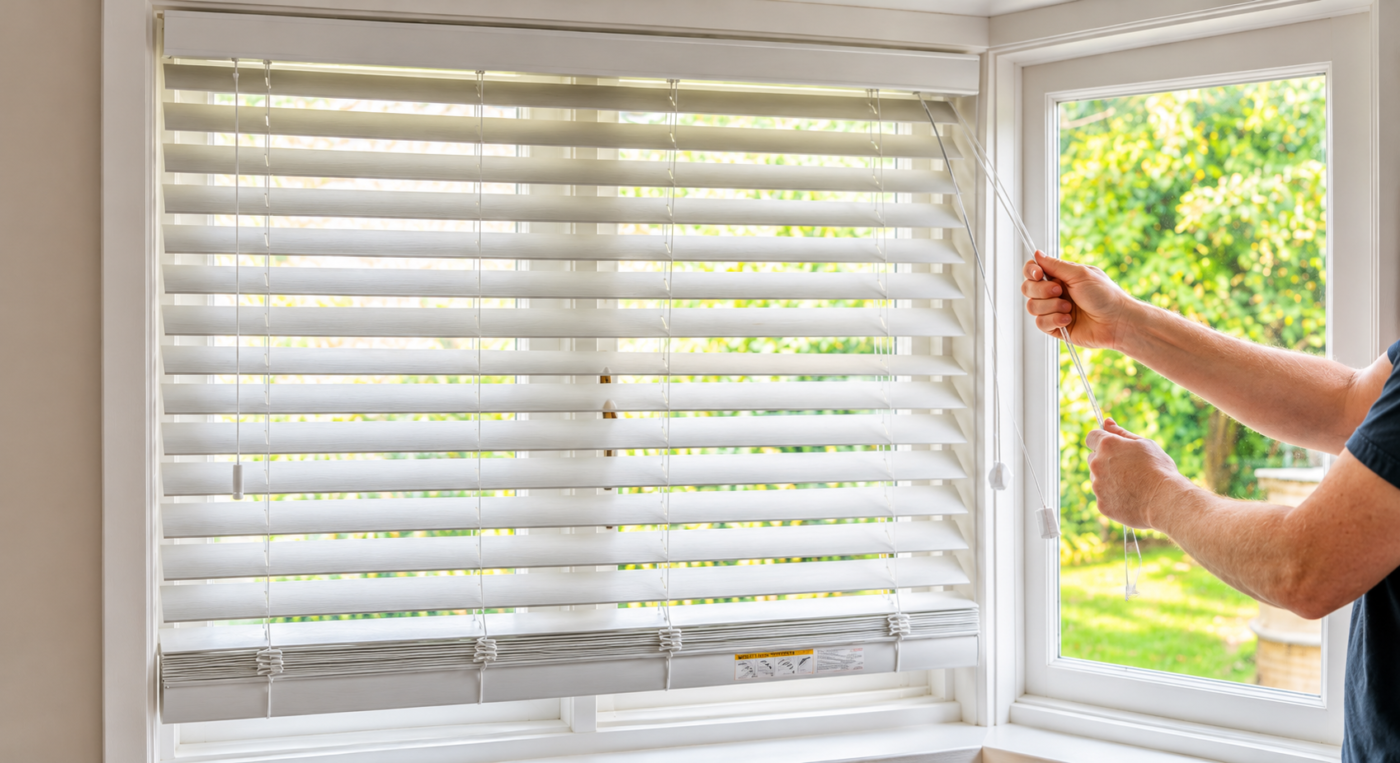
Opening Venetian blinds involves two separate operations: adjusting the slat angle and raising the blind.
Although the precise operating method depends on the mechanism fitted to your particular blind, the following approach is suitable as a general guide.
Step 1: Check the position of the slats

Before attempting to raise your Venetian blind, make sure that the slats are positioned correctly.
As a general operating precaution, position the slats horizontally before raising the blind.
This helps prevent unnecessary resistance and reduces the possibility of the lifting cords catching against the slats.
Step 2: Identify the correct lifting cord

On traditional cord-operated Venetian blinds, the lifting cord is normally located at one side of the headrail.
Do not confuse this with the tilt control.
If your blind has separate operating controls, identify which one raises and lowers the blind and which one adjusts the slat angle.
Step 3: Release the cord lock

Many traditional Venetian blind mechanisms incorporate an automatic cord-locking system.
To release it, the lifting cord generally needs to be pulled gently in a particular direction or at a particular angle.
The precise direction varies between mechanisms.
Some systems require the cord to be moved towards the centre of the blind before lowering, while others use a different release arrangement.
Always follow the operating instructions supplied with your particular blind.
Step 4: Raise the blind gradually

Once the cord lock has released, pull the lifting cord downwards using a controlled movement.
The blind should begin to rise.
Continue until the desired height has been reached, avoiding sudden movements or excessive force.
Step 5: Lock the blind into position

When the blind reaches the required height, operate the cord lock according to the manufacturer’s instructions.
On many conventional systems, moving the cord away from the centre of the blind engages the locking mechanism.
Release the cord carefully and check that the blind remains securely in position.
Remember: Never force a Venetian blind upwards if it appears to be stuck. Stop, check the slat position and investigate whether the cord or mechanism is obstructed.
How to Close Venetian Blinds Correctly
Lowering Venetian blinds is another operation where incorrect cord handling can cause problems.
The objective is to release the lifting mechanism gradually and allow the blind to descend evenly.
Step 1: Identify the lifting cord
Locate the correct lifting cord rather than attempting to operate the tilt mechanism.
Using the wrong control will not release the lifting mechanism and may result in unnecessary pulling or twisting.
Step 2: Release the cord lock
Follow the instructions for your particular cord-lock mechanism.
On many traditional Venetian blinds, the cord needs to be moved towards the centre of the blind to release the locking mechanism.
Do this gently rather than pulling sharply.
Step 3: Allow the blind to descend
Once released, guide the lifting cord through your hand and allow the blind to lower gradually.
Avoid allowing the blind to drop freely.
A controlled descent helps prevent sudden movement and unnecessary stress on the internal components.
Step 4: Stop at the desired position
When the blind reaches the required height, engage the cord lock using the manufacturer’s recommended procedure.
Check that both sides of the blind remain level and that the slats are hanging correctly.
Step 5: Adjust the slats for privacy and daylight
Once the blind is lowered, use the tilt mechanism to position the slats as required.
You can now adjust the amount of natural daylight entering the room while maintaining the level of privacy you prefer.
The Most Common Mistakes When Operating Venetian Blinds
Even well-manufactured Venetian blinds can experience unnecessary wear when operated incorrectly.
Here are some of the most common mistakes to avoid.
Mistake 1: Pulling the wrong cord
This is probably one of the most frequent mistakes made by inexperienced Venetian blind owners.
Traditional cord-operated systems may have separate controls for lifting and tilting.
Pulling the lifting cord when you intend to adjust the slats will not achieve the desired result.
Similarly, repeatedly pulling the tilt control when attempting to raise the blind can create unnecessary confusion and place additional strain on the mechanism.
The solution: Familiarise yourself with the operating controls before using the blind. Identify the lifting and tilting mechanisms and understand their individual functions.
Mistake 2: Pulling both cords simultaneously
Where a blind has separate operating cords, pulling both at the same time can interfere with the intended operation.
It may also cause confusion about which mechanism is being activated.
The solution: Operate each control independently and follow the manufacturer’s instructions.
Mistake 3: Pulling the lifting cord too hard
Venetian blinds are designed to operate using controlled movements.
They should not require excessive force.
Pulling too aggressively can place unnecessary strain on the lifting cords, cord lock and internal components.
The solution: Use steady, controlled movements. If the blind does not respond, stop and investigate rather than increasing the pulling force.
Mistake 4: Raising the blind with the slats fully closed
This is an important operating mistake.
When the slats are fully tilted into a closed position, the lifting cords and ladder system may experience additional friction or resistance as the blind rises.
This can contribute to uneven lifting and premature wear.
The solution: Return the slats to their horizontal position before raising or lowering the blind, unless the manufacturer’s instructions specify otherwise.
Mistake 5: Tilting the slats too far
Venetian blinds are designed to provide adjustable light control, but their tilt mechanisms have an intended operating range.
Forcing the tilt wand or cord beyond its natural stopping point can damage internal components.
The solution: Adjust the slats gradually. Stop when you reach the mechanism’s natural limit.
Mistake 6: Allowing the cords to become tangled
Tangled cords can prevent the blind from operating correctly.
They may also interfere with the lifting mechanism and create an uneven appearance.
The solution: Keep operating cords organised and ensure that the supplied safety devices are correctly installed and maintained.
Never modify, tie together or remove safety components to make a blind operate differently.
Mistake 7: Pulling the blind from the bottom rail
Another common mistake is attempting to raise or lower a Venetian blind by pulling directly on the bottom rail.
The bottom rail is designed to support the slats, not replace the lifting mechanism.
Pulling or pushing it unevenly can affect the alignment of the blind.
The solution: Always use the designated operating controls.
Why Your Venetian Blinds Might Not Open or Close Properly
If your Venetian blinds suddenly become difficult to operate, the problem may not necessarily mean that the blind needs replacing.
Several issues can affect its performance.
The cord lock may not be releasing
A cord-lock mechanism that does not release correctly can prevent the blind from moving.
Check that you are following the correct operating procedure for your particular system.
Do not dismantle the headrail unless you have the appropriate instructions and technical knowledge.
The lifting cords may be uneven
If one side of the blind rises higher than the other, the lifting cords or internal components may require attention.
Uneven movement can also result from an obstruction or a problem with the lifting mechanism.
The slats may be obstructed
Dust, debris or incorrectly aligned slats can interfere with normal operation.
Check that the slats are sitting correctly and that nothing is preventing their movement.
The tilt mechanism may be damaged
If the slats no longer rotate correctly, the problem may involve the tilt wand, cord mechanism, ladder or internal gearing.
Do not force the mechanism to turn.
The operating mechanism may be worn
Like any mechanical component, Venetian blind mechanisms can experience wear over time.
If the blind repeatedly becomes stuck, slips downwards or refuses to lock into position, it may need professional attention or replacement parts.
Grays Window Blinds offers a comprehensive range of spare parts for its blind types. If you need assistance identifying a replacement component, visit our website.
Operating Different Types of Venetian Blinds
Not all Venetian blinds are manufactured using the same materials or operating mechanisms.
Understanding the differences can help you select the right product and operate it correctly.
Aluminium Metal Venetian Blinds
Aluminium Venetian blinds are particularly popular in kitchens, bathrooms, offices and contemporary living spaces.
Their lightweight horizontal slats provide excellent flexibility when controlling daylight and privacy.
Available in different slat widths, including 15mm, 25mm, 35mm and 50mm configurations, aluminium Venetian blinds are a practical choice for many different window sizes.
When operating them, avoid excessive force and ensure the slats are correctly positioned before raising or lowering the blind.
Faux Wood Venetian Blinds
Faux wood Venetian blinds provide the appearance of traditional wooden slats while offering a different material construction.
They are particularly attractive in living rooms, bedrooms, kitchens and other areas where a warmer interior appearance is desired.
Grays Window Blinds offers different configurations, including:
- 38mm Faux Wood Venetian with Ladder Cord.
- 50mm Faux Wood Venetian with Ladder Cord.
- 50mm Faux Wood Venetian with Fabric Tape.
- 63mm Faux Wood Venetian with Ladder Cord.
Because faux wood slats can be heavier than aluminium alternatives, operating the lifting mechanism smoothly is particularly important.
Avoid pulling the cords abruptly or attempting to lift the blind while the slats are incorrectly positioned.
Solid Wood Venetian Blinds
Solid wood Venetian blinds provide a traditional, natural appearance and can make a significant contribution to the overall interior design of a room.
Available in 50mm configurations with ladder cord or fabric tape, they offer adjustable daylight control and a distinctive decorative finish.
Because the slats are made from solid wood, they can be heavier than aluminium alternatives.
Always use the correct lifting mechanism and avoid sudden movements.
Venetian Blind Cord Safety: Important Advice for Homes with Children
Correct operation is important, but safety must always come first.
Blind cords and chains can present a serious strangulation hazard to babies and young children.
This is not simply a matter of keeping cords tidy. A loose or accessible loop can create a potentially life-threatening situation.
The Competition and Consumer Protection Commission (CCPC) in Ireland provides specific guidance on window blind safety, including Venetian blinds.
Important precautions include:
- Keep all blind cords and chains out of reach of young children.
- Ensure appropriate safety devices are correctly installed.
- Keep furniture, beds, cots and playpens away from windows with accessible blind cords.
- Regularly inspect cords, chains and safety devices.
- Follow the manufacturer’s installation and operating instructions.
- Consider cordless alternatives where appropriate.
The CCPC advises that cords and chains should be kept at least 1.6 metres above the ground and secured using appropriate safety devices.
The relevant European safety standards include EN 13120, EN 16433 and EN 16434.
The safest approach is to eliminate children’s access to cords and chains altogether. Safety devices reduce risks but cannot guarantee that a blind is completely risk-free.
For further information, consult the Irish CCPC’s official window blind safety guidance:
How to Maintain Your Venetian Blinds for Longer
Regular maintenance can help preserve the appearance and performance of your Venetian blinds.
Fortunately, most routine maintenance is straightforward.
1. Remove dust regularly
Use a soft microfibre cloth or an appropriate blind-cleaning tool to remove accumulated dust.
For easier cleaning, adjust the slats so that their surfaces are accessible.
Avoid applying excessive pressure.
2. Clean the slats carefully
For suitable aluminium and faux wood blinds, use a lightly dampened cloth where appropriate.
Always follow the cleaning instructions supplied with the product.
Solid wood blinds require additional care because excessive moisture can damage the material.
3. Inspect the operating cords
Occasionally check the lifting cords and tilting controls for visible signs of wear, fraying or damage.
If you notice anything unusual, stop using the affected mechanism and seek advice.
4. Check the headrail
Ensure that the headrail remains securely positioned and that there are no obvious obstructions affecting the mechanism.
5. Avoid unnecessary force
The best maintenance practice is often simply to operate your blinds correctly.
Smooth movements and sensible handling can help reduce unnecessary wear.
Buying Made-to-Measure Venetian Blinds Online in Ireland
If you are considering replacing your existing Venetian blinds, buying made-to-measure window blinds online can be a convenient and cost-effective alternative to traditional showroom shopping.
At Grays Window Blinds, we provide customers throughout Dublin and the Republic of Ireland with access to a comprehensive selection of made-to-measure window blinds.
Our online shopping platform allows you to browse different products, compare available colours, select your preferred specifications and purchase directly through our website.
Whether you are looking for aluminium Venetian blinds, faux wood Venetian blinds or solid wood Venetian blinds, you can explore the available options and select the product that best suits your requirements.
Why buy Venetian blinds online?
There are several advantages to purchasing directly online:
Greater choice: Browse different materials, slat widths, colours and configurations.
Competitive online pricing: Take advantage of online discounts and promotional offers.
Made-to-measure specifications: Select the dimensions required for your individual windows.
Convenience: Complete your purchase without travelling to a showroom.
Nationwide delivery: Order your blinds online and have them delivered throughout Ireland.
Measuring your own Venetian blinds
One of the most important stages of purchasing made-to-measure blinds is obtaining accurate measurements.
Before placing your order, carefully read the measuring instructions provided for your chosen product.
Different fitting arrangements may require different measurements, particularly when deciding between recess fitting and face fitting.
Always double-check your measurements before submitting your order.
Remember that the measurements entered during an online purchase determine the dimensions of the product manufactured for you.
Taking the time to measure accurately can help avoid unnecessary ordering mistakes.
Ordering your Venetian blinds
Once you have completed your measurements, you can proceed to the relevant product page on the Grays Window Blinds website.
Select the appropriate specifications, choose your preferred colour and enter the required measurements.
Review your selections carefully before completing checkout.
Our website is designed to help customers purchase their blinds directly online, without the additional expense of traditional showroom shopping.
Fitting your own Venetian blinds
You do not necessarily need to employ an installer to fit your new window blinds.
With the correct tools, accurate measurements and suitable preparation, many customers can complete the installation themselves.
Grays Window Blinds provides comprehensive fitting instructions covering our different blind types.
We encourage customers to familiarise themselves with the relevant instructions before starting installation.
Read through the guide, check that you have the required tools and identify the fixing points before beginning.
Following the correct installation procedure can make the process considerably easier.
For customers who prefer professional assistance, additional service options are also available where applicable.
Why Choose Grays Window Blinds?
Established in Dublin on 6 February 1991, Grays Window Blinds has more than 35 years of experience in the window blinds industry.
Our objective has always been to provide quality products, competitive prices and helpful customer service.
Today, our online platform gives customers throughout Ireland the opportunity to browse and purchase made-to-measure domestic and commercial window blinds.
Our extensive product selection includes:
- Metal Venetian Blinds.
- Metal Venetian Perfect Fit Blinds.
- Faux Wood Venetian Blinds.
- Solid Wood Venetian Blinds.
- Roller Blinds.
- Roller Cassette Blinds.
- Roller Dual Shade Blinds.
- Roller Perfect Fit Blinds.
- Vertical Blinds and Vertical Louvres.
- Roman Blinds.
- BlocOut Roof Window Blinds.
We also offer a comprehensive selection of fabrics and configurations to accommodate different requirements.
Our online platform is designed to give customers greater control over the purchasing process.
You can research your preferred blind, measure your windows, select your specifications, place your order and complete the fitting yourself using our installation instructions.
By purchasing directly online, you can benefit from competitive prices without the additional showroom overheads associated with traditional retail.
Grays Window Blinds: Established in Dublin in 1991. Quality window blinds, competitive online prices and nationwide delivery.
Visit https://www.grayswindowblinds.ie/ to browse our full collection.
Frequently Asked Questions About Operating Venetian Blinds
1. Which cord do I pull to open Venetian blinds?
On traditional cord-operated Venetian blinds, the lifting cord raises and lowers the blind, while a separate wand or tilt control adjusts the angle of the slats. The precise arrangement depends on the mechanism fitted.
2. Why will my Venetian blinds not go up?
Possible reasons include an engaged cord lock, incorrectly positioned slats, tangled lifting cords or a problem with the internal mechanism. Check the operating instructions and never force the lifting cord.
3. Should Venetian blind slats be open or closed when raising the blind?
As a general rule, position the slats horizontally before raising or lowering the blind. This helps reduce friction and unnecessary strain on the lifting mechanism.
4. Why do my Venetian blinds get stuck when lowering?
The cord lock may not have released correctly, or the lifting cords may be obstructed. Check the operating procedure for your particular blind and avoid pulling aggressively.
5. Can you tilt Venetian blinds without raising them?
Yes. The tilt mechanism is designed to adjust the angle of the slats independently of the lifting mechanism. This allows you to control daylight and privacy while keeping the blind at its existing height.
6. Why are my Venetian blinds uneven?
Uneven lifting can be caused by tangled or worn cords, an obstruction or an internal mechanism problem. If the blind remains uneven after checking for obvious obstructions, contact your supplier.
7. Are aluminium Venetian blinds better than faux wood Venetian blinds?
Neither is universally better. Aluminium blinds are lightweight and particularly suitable for contemporary interiors, offices and many kitchens. Faux wood blinds offer a different decorative appearance and are available in a variety of slat widths and finishes. Your choice should depend on the room, appearance and practical requirements.
8. How do I clean Venetian blinds?
Regularly remove dust using a soft cloth or suitable cleaning tool. Use cleaning methods appropriate to the material, taking particular care with solid wood blinds and avoiding excessive moisture.
9. Can I purchase made-to-measure Venetian blinds online in Ireland?
Yes. Grays Window Blinds allows customers to browse and purchase made-to-measure Venetian blinds online. You can select your preferred product, enter your measurements and complete your order through our website.
10. Can I measure and fit my own Venetian blinds?
Yes. Customers can measure their windows, order their preferred blinds and undertake the installation themselves. Grays Window Blinds provides comprehensive fitting instructions to assist customers throughout the process.
Final Thoughts: Operate Your Venetian Blinds the Right Way
Venetian blinds are designed to provide years of practical use, attractive styling and excellent control over natural daylight.
However, understanding the correct operating procedure is essential.
Remember to identify the lifting and tilting controls, position the slats correctly before raising or lowering the blind, avoid excessive force and ensure that all safety devices remain correctly installed.
A little knowledge and sensible handling can make a considerable difference to the performance and lifespan of your window blinds.
If you are considering new window blinds for your home, apartment, office or commercial premises, Grays Window Blinds offers an extensive online collection of made-to-measure products.
From aluminium Venetian blinds and faux wood Venetian blinds to traditional solid wood Venetian blinds, you can browse the available options, measure your own windows, place your order and complete the fitting using our comprehensive online instructions.
Why pay more when you can measure, order and fit your own quality window blinds online?
Visit www.grayswindowblinds.ie today and explore our full range of made-to-measure window blinds.
Established 1991 | Competitive Online Prices | Nationwide Delivery
Join the Conversation
Have you ever pulled the wrong cord when trying to operate your Venetian blinds? Have you experienced problems raising, lowering or tilting your blinds?
We would love to hear about your experiences.
Leave a comment on our Facebook or social media pages, share this article with friends and family, and follow Grays Window Blinds for more useful advice, product information, measuring guidance and fitting tips.
If you found this guide helpful, please like and share it.
Grays Window Blinds – Helping Ireland make better choices when buying window blinds online.
