


 Be Inspired
 Roller Fabrics
 Vertical Fabrics
 Roman Fabrics





Blog Post
Flame-Retardant Fabrics For The Commercial Industry
Oct
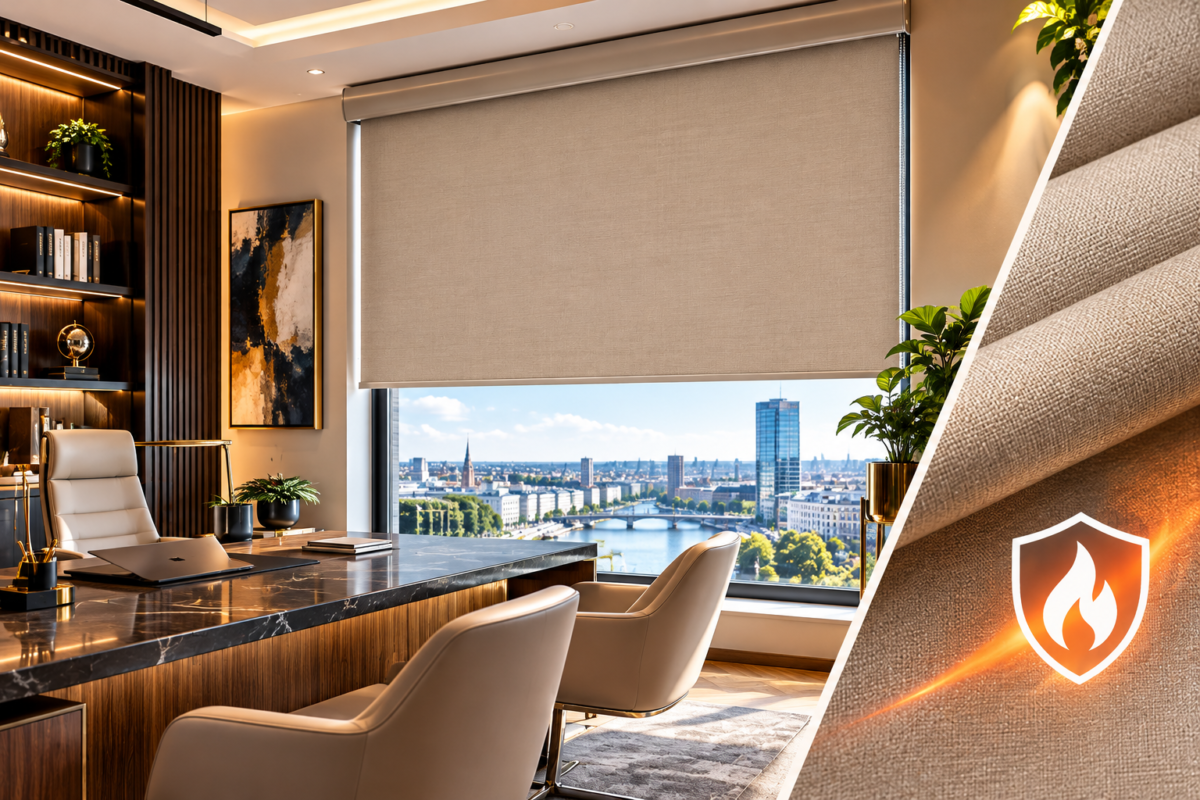
Commercial Window Blinds Designed Around Safety, Performance and Professional Standards
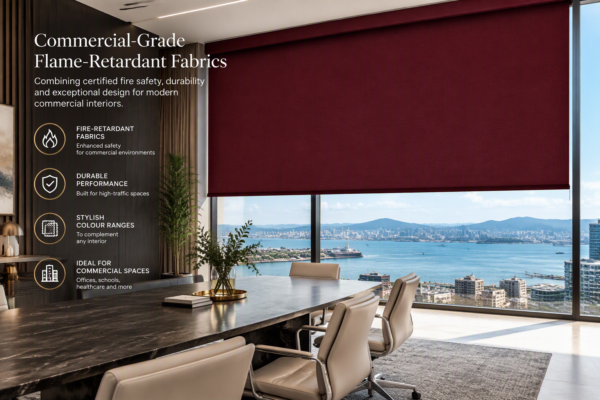
Choosing flame-retardant facrics for commercial windows is an important consideration for businesses, schools, healthcare facilities, hotels, offices and public buildings throughout Dublin and the Republic of Ireland. Commercial window coverings must do more than control sunlight. They should also meet the project’s documented fire-safety requirements, support everyday operations, provide appropriate privacy and contribute to a professional working environment.
At Grays Window Blinds, we supply made-to-measure window blinds for domestic and commercial applications, with online supply-only options and measuring, supply and fitting services where required. Our commercial range includes vertical commercial fabrics, flame-retardant roller fabrics and a variety of other window blind systems suitable for different interior requirements.
For facilities managers, architects, contractors, procurement teams and business owners searching for flame-retardant commercial blinds in Dublin, the key is to select a product whose documented performance, fabric construction, operating system and dimensions are appropriate for the building.
Whether you are fitting out a new office in Dublin, refurbishing a school in Finglas, upgrading a healthcare environment or sourcing commercial window blinds for a project elsewhere in Ireland, the right specification can make procurement more straightforward and help avoid costly mistakes.
Visit www.grayswindowblinds.ie to explore our window blind solutions.
What Are Flame-Retardant Blinds?
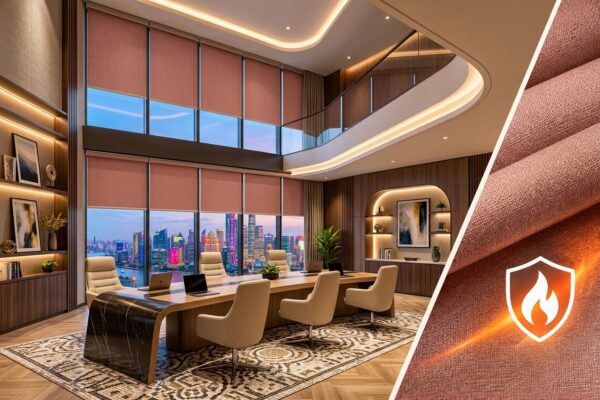
Flame-retardant blinds are window coverings manufactured using fabrics or materials designed to meet specified fire-performance criteria. Depending on the product, the fabric may incorporate flame-retardant properties or receive a treatment intended to reduce its ignitability or affect how fire spreads across its surface.
These products are particularly relevant to commercial premises where the fire strategy, building specification, project brief or responsible building professional requires documented fire-performance characteristics for interior materials.
However, an important distinction must be understood: flame-retardant does not mean fireproof. Such materials should not be described as incapable of burning, nor should their use be taken as a guarantee of building fire safety.
The suitability of a particular blind depends on its tested performance, the applicable specification, the installation and the environment in which it will be used.
For example, a contractor sourcing flame-retardant roller blinds for a commercial office should confirm that the exact fabric selected has the required supporting documentation. The same principle applies to vertical blinds installed in a school, a commercial building or a healthcare facility.
This is why selecting commercial blinds should begin with the project requirements rather than colour or price alone.
Why Flame-Retardant Commercial Blinds Matter in Ireland
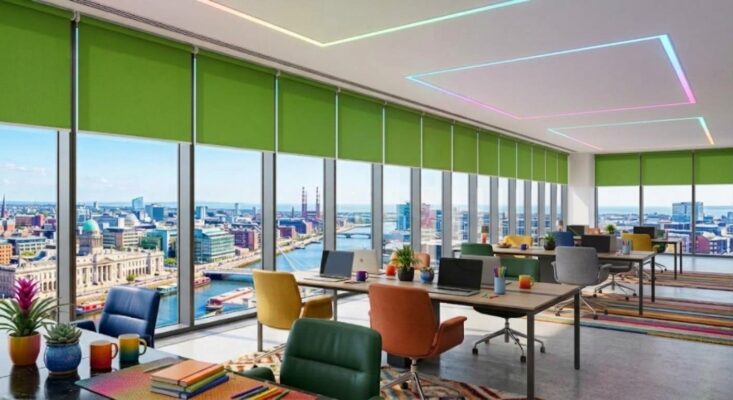
Commercial buildings accommodate employees, customers, students, visitors and service users every day. Window coverings form part of the interior environment and should be selected with the building’s intended use in mind.
In Ireland, the Department of Housing, Local Government and Heritage publishes Technical Guidance Document B concerning fire safety in buildings other than dwelling houses. The current published edition includes the 2024 guidance as reprinted in January 2026.
The applicable requirements depend on the building, its use and the work being undertaken. Project teams should consult the relevant guidance and competent fire-safety professionals rather than assume that one fabric classification applies to every commercial installation.
Official guidance: Technical Guidance Document B – Fire Safety.
Offices and Corporate Buildings
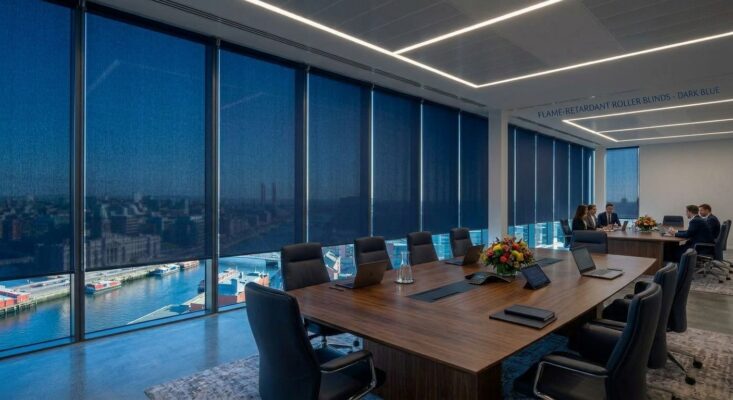
Offices require window coverings that support productivity, manage glare and provide privacy for meetings, computer workstations and shared spaces.
Flame-retardant commercial roller blinds can be considered where the specification calls for suitable tested fabrics. Vertical blinds may also be appropriate for larger windows, depending on the required performance and appearance.
For offices in Dublin city centre, business parks and commercial developments throughout Ireland, the selection process should consider daylight control, maintenance, fabric documentation and the practical demands of the workplace.
Schools, Colleges and Educational Facilities
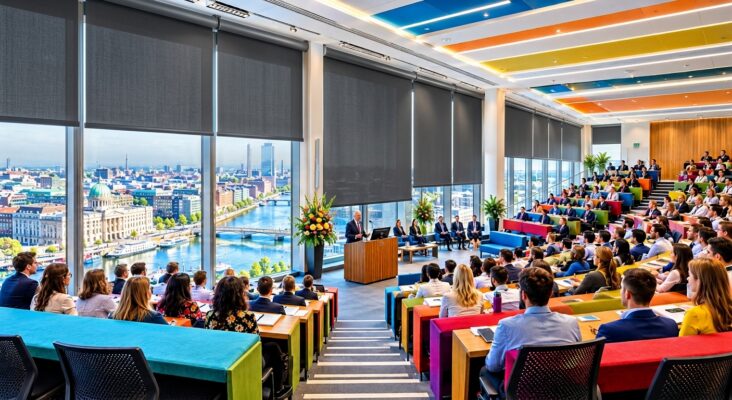
Educational environments need durable, functional window coverings that can withstand frequent daily use.
Classrooms may require glare reduction for interactive displays, privacy in ground-floor rooms and improved control over incoming daylight. Staff rooms, libraries, administration offices and corridors may have different requirements.
Where a school specification calls for flame-retardant blinds, procurement teams should obtain evidence relating to the precise fabric being offered. A generic statement that a product is suitable for commercial use is not a substitute for the required test report or classification.
Healthcare and Care Environments
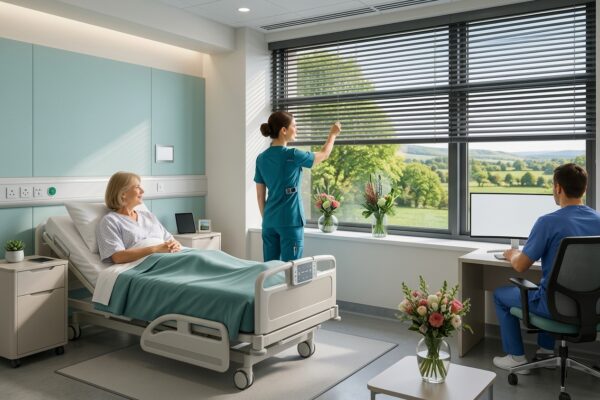
Healthcare premises can have specific requirements concerning hygiene, cleaning, durability, privacy and fire performance.
The appropriate blind depends on the room’s function, the cleaning regime, the installation location and the project specification. A fabric suitable for an administrative office may not be appropriate for every clinical or specialist care environment.
Facilities managers should establish these requirements before selecting fabrics or requesting quotations.
Hotels, Restaurants and Hospitality Venues
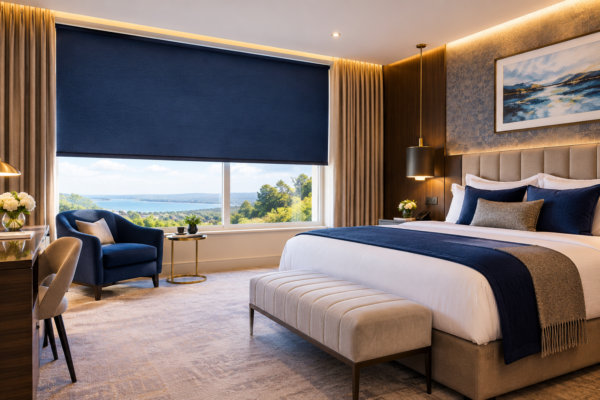
Hotels and hospitality businesses need window coverings that contribute to the guest experience while meeting the project’s practical and safety requirements.
Roller blinds, vertical blinds and Roman blinds may each suit different rooms. Guest bedrooms might prioritise privacy and light reduction, while conference rooms may require glare control and a consistent appearance across multiple windows.
Where flame-retardant performance is specified, the chosen material must have supporting evidence appropriate to its intended application.
Understanding Fire-Retardant Fabric Standards
One of the most important steps when buying flame-retardant blinds in Ireland is understanding the difference between a product description and a verified fire-performance classification.
A fabric supplier may describe a material as flame-retardant, but commercial buyers should establish what that claim means and which test method supports it.
EN 13773: What Does It Cover?
EN 13773:2003, titled Textiles and textile products – Burning behaviour – Curtains and drapes – Classification scheme, specifies a classification scheme for the burning behaviour of vertically oriented fabrics intended for curtains, drapes and similar applications, including blinds where relevant.
The standard addresses the classification of burning behaviour. Untested materials cannot automatically be treated as classified under this standard.
For projects specifying EN 13773, buyers should request the relevant evidence and confirm the required classification with the project designer, fire consultant or responsible specifier.
Reference: NSAI – EN 13773:2003.
It is equally important not to assume that EN 13773 is the correct or sufficient standard for every project. The required test method and acceptance criteria depend on the specification and the intended application.
What Documentation Should You Request?
Before approving a commercial blind fabric, request the relevant documentation from the supplier or manufacturer.
This may include:
- The precise fabric name, range and product reference.
- The applicable fire-test report or classification certificate.
- The standard and test method used.
- The classification or performance result achieved.
- Confirmation that the evidence applies to the proposed fabric and construction.
- Any conditions or limitations associated with the test result.
- Relevant installation, cleaning and maintenance instructions.
Where a project requires a particular classification, the documentation should be checked against the exact requirement rather than accepted on the basis of a broad marketing description.
This process is particularly important for public-sector procurement, commercial refurbishment projects and buildings where the specification has been developed by an architect or fire-safety consultant.
The Best Types of Commercial Blinds for Different Applications
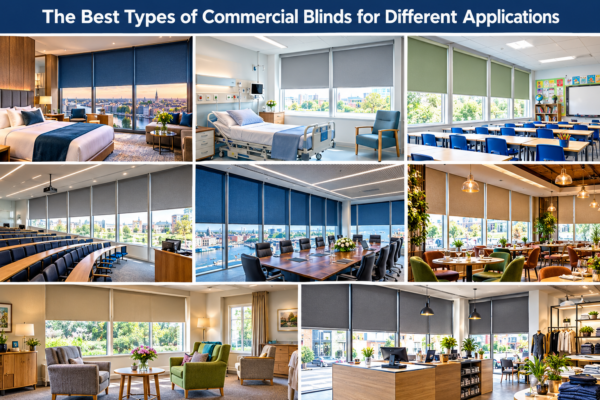
The ideal commercial blind depends on the window dimensions, room function, desired light control, operating requirements and specification.
At Grays Window Blinds, several blind systems can be considered for commercial applications. The key is to match the product to the project rather than assume that every blind style is available with every required fire-performance characteristic.
1. Flame-Retardant Roller Blinds
Roller blinds are a practical choice for many commercial interiors because their straightforward design suits offices, meeting rooms, staff areas and other professional environments.
The fabric rolls around a tube, allowing the blind to be raised or lowered to control incoming daylight and privacy.
For commercial projects, roller blinds can offer:
- A neat, consistent appearance across multiple windows.
- A choice of fabric colours and levels of light transmission.
- Straightforward operation.
- Options for different window sizes.
- A relatively unobtrusive appearance when raised.
Where flame-retardant performance is required, specify the exact commercial roller fabric and request the appropriate supporting documentation.
A decorative roller fabric should not be assumed to meet a commercial fire specification simply because it looks similar to a tested material.
2. Flame-Retardant Vertical Blinds
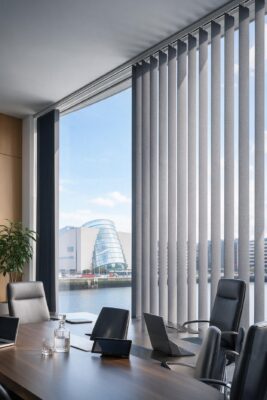
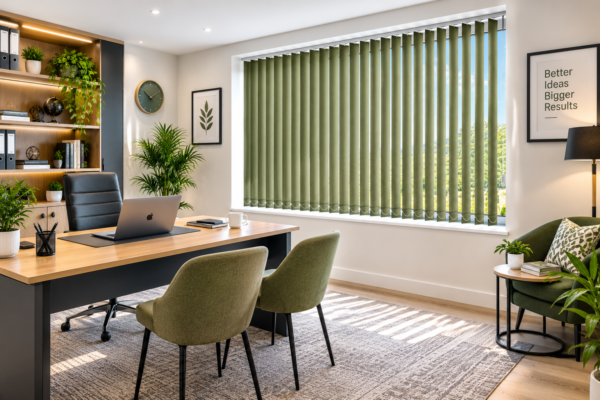
Vertical blinds are particularly useful for wide windows and glazed areas where adjustable louvres can help manage incoming light.
The individual louvres rotate to change the angle of daylight entering the room. They can also be drawn aside, depending on the track configuration.
This makes vertical blinds worth considering for:
- Corporate offices.
- School classrooms.
- Training rooms.
- Meeting and conference facilities.
- Commercial buildings with large windows.
- Certain reception and administration areas.
Grays Window Blinds offers vertical commercial fabrics designated as flame-retardant within its product range. Project buyers should confirm the available fabric references, performance documentation and suitability for the intended installation before specifying them.
Vertical blinds can also provide a consistent appearance across a large number of windows, helping maintain a coordinated interior design.
3. Roller Cassette Blinds
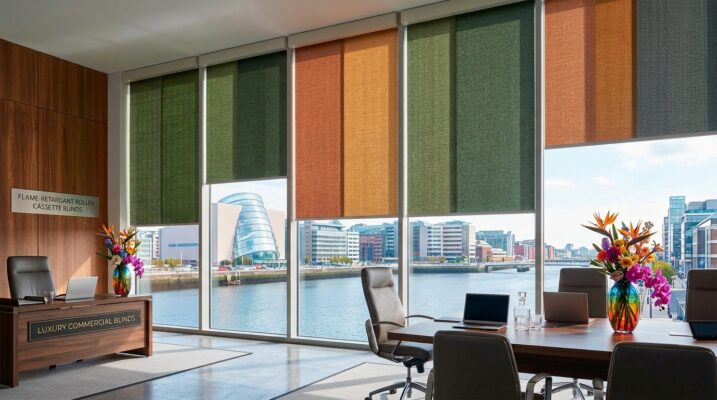
Roller cassette blinds incorporate a headbox that houses or conceals the roller mechanism, depending on the system.
They can be useful where a more finished appearance is desired, particularly in modern offices, meeting rooms and reception areas.
The cassette system may help protect the roller mechanism from dust, although the actual benefits depend on the design and installation.
Commercial buyers should verify whether a proposed cassette configuration can be supplied with the required fabric and documentation. A flame-retardant fabric certificate should not automatically be assumed to cover every component of the assembled blind.
4. Roller Dual Shade Blinds
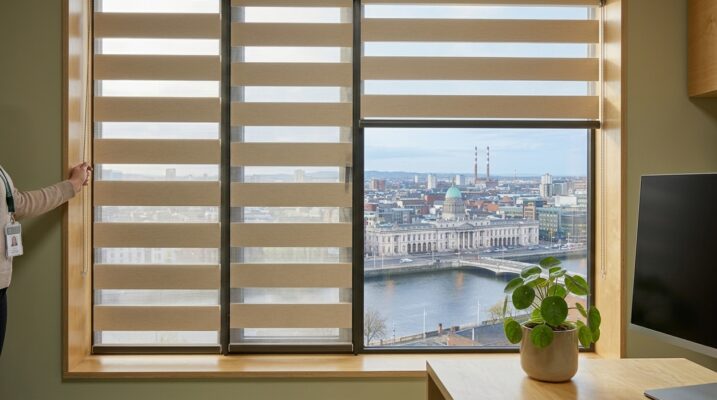
Dual shade blinds use alternating fabric bands to provide adjustable light control.
They can create a contemporary appearance in selected office and commercial interiors, particularly where visual design is an important consideration.
Before specifying this system for a regulated or safety-sensitive project, confirm the availability of the required fire-performance evidence for the exact fabric and construction.
5. Roman Blinds
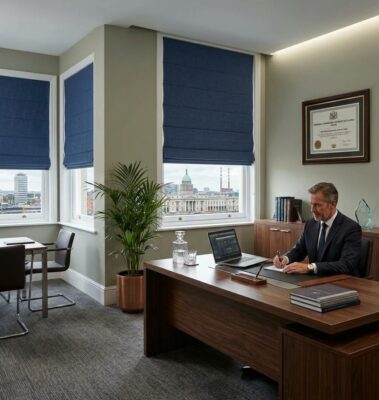
Roman blinds fold into horizontal sections as they are raised, creating a softer, more traditional appearance.
They may suit certain hospitality settings, executive offices and reception areas. However, their layered construction and fabric requirements should be considered carefully when a commercial fire specification applies.
Do not assume that a standard Roman fabric or lining is suitable for a project requiring documented flame-retardant performance.
6. Venetian Blinds

Metal Venetian, faux wood Venetian and solid wood Venetian blinds offer adjustable slats for light control and privacy.
These products may be appropriate for particular commercial interiors, but their material composition differs from that of textile roller or vertical blinds.
Where the specification concerns flame-retardant textiles, confirm which components and materials are covered by the relevant requirement. Do not treat a textile classification as automatically applicable to metal, wood, faux wood or an entire assembled blind.
How to Specify Flame-Retardant Blinds for Commercial Windows
A well-prepared specification helps architects, contractors, facilities managers and purchasing departments compare quotations accurately.
Rather than requesting commercial blinds using only a general description, establish the technical and operational requirements before ordering.
Step 1: Identify the Building Type
Begin by defining the intended application.
Is the project an office refurbishment, a school extension, a healthcare facility, a hotel fit-out or a commercial development?
The answer helps determine which requirements must be considered and which professionals should approve the proposed products.
Step 2: Confirm the Fire-Performance Requirement
Ask the architect, fire consultant or responsible project professional to identify the required standard, test method and acceptance criteria.
If a specific classification is required, include it in the quotation request.
Avoid vague descriptions such as “commercial grade” or “fire-safe fabric” where the project requires formal evidence.
Step 3: Select the Appropriate Blind System
Decide whether the application calls for roller blinds, vertical blinds or another suitable window covering.
Consider the window width and height, the available fixing surface, the room layout and the level of light control required.
For large glazed areas, vertical louvres may be appropriate. For individual office windows, roller blinds may provide a simpler solution.
Step 4: Establish Light-Control Requirements
Not all commercial blinds serve the same purpose.
Some rooms require reduced glare while retaining natural daylight. Others may need greater privacy or a higher degree of light exclusion.
Dimout and blackout fabrics should not be confused with flame-retardant fabrics. These terms describe different properties, and one does not automatically imply the other.
Where both fire-performance and blackout performance are required, request evidence for each relevant characteristic.
Step 5: Measure Every Window Accurately
Accurate measurements are essential for made-to-measure commercial window blinds.
Record the width and height of each opening, the intended fixing position and any obstructions that could affect installation.
Check whether the blind will fit inside the recess or be installed outside it. Confirm the available depth for brackets, headrails and any cassette system.
For larger projects, use a window schedule identifying each room, window reference, dimensions, fabric selection and operating requirements.
Step 6: Confirm the Operating System
The operating system should suit the users and the environment.
Depending on the application, the project may call for a conventional chain-operated blind, a wand-operated vertical blind or another suitable operating arrangement.
The specification should address accessibility, safe operation, maintenance and any project-specific restrictions. Specialist environments may require additional assessment.
Step 7: Obtain Written Confirmation Before Approval
Before placing an order, ensure the fabric selection, measurements, operating system and required documentation have been reviewed.
Where the project has formal approval procedures, obtain written confirmation from the responsible person before manufacturing begins.
This final check can reduce the risk of ordering a visually suitable blind that fails to meet the project’s technical requirements.
Flame-Retardant Blinds for Offices in Dublin and Across Ireland

Commercial property owners searching for commercial window blinds in Dublin often need a supplier capable of supporting projects across multiple locations.
A Dublin office refurbishment may involve a small number of meeting-room windows, while a nationwide organisation may require consistent blind specifications across several buildings.
Grays Window Blinds serves customers seeking made-to-measure window blinds, with online supply-only purchasing and measured, supplied and fitted options where required.
Our product portfolio includes roller blinds, roller cassette blinds, vertical blinds, Roman blinds, metal Venetian blinds, faux wood Venetian blinds and other specialist window covering systems.
For commercial enquiries, the most useful starting point is to provide the location, number of windows, approximate dimensions, preferred blind type and any relevant fabric or fire-performance specification.
Commercial Blinds in Dublin 11 and Finglas
Businesses looking for blinds in Finglas, commercial roller blinds in Dublin 11 or a quick quote for a Dublin commercial property should provide sufficient information to establish the scope of the project.
A quotation request can include photographs of the windows, a schedule of measurements and the project specification.
This helps identify the appropriate next steps and makes it easier to determine whether a particular fabric or blind system can meet the stated requirements.
Commercial Blinds Outside Of Dublin
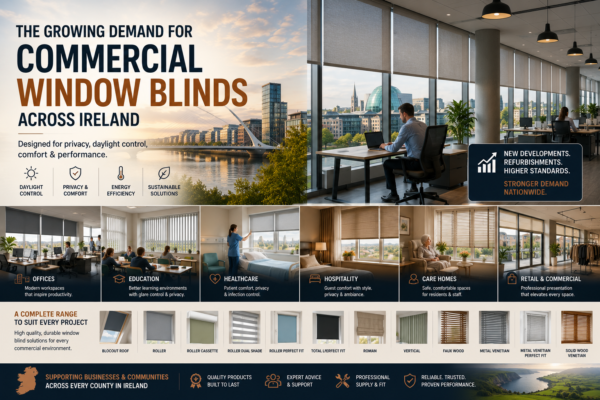
Organisations sourcing window blinds in Ireland may also require products for premises in Cork, Galway, Limerick, Waterford, Wexford and other locations throughout the Republic of Ireland.
For supply-only projects, confirm delivery arrangements, dimensions, installation responsibilities and documentation before ordering.
For projects requiring professional fitting, confirm the installation scope and availability for the relevant location.
The most important consideration is consistency: each blind should match the approved product specification and the dimensions of its intended window.
Balancing Fire Performance, Light Control and Appearance
Commercial window coverings need to perform well in everyday use. Fire-performance documentation is important when required, but it is not the only factor to consider.
Glare Reduction
Direct sunlight can make computer screens difficult to read and affect comfort in offices and classrooms.
The fabric’s openness, colour, construction and position influence how much light enters the room. The correct selection depends on the orientation of the windows and the work being carried out.
Privacy
Ground-floor offices, consultation rooms and meeting spaces may need greater privacy than other areas.
The selected fabric should provide the required level of visual screening without compromising other essential requirements.
Colour and Interior Design
Neutral colours can support a consistent corporate appearance, while carefully selected accent colours can help distinguish departments or create visual interest.
For multi-site organisations, standardising the fabric reference can help maintain a consistent appearance across locations.
Cleaning and Maintenance
Commercial blinds should be selected with the cleaning requirements of the building in mind.
Ask for the manufacturer’s care instructions and confirm whether the proposed cleaning method could affect any relevant fabric treatment or performance claim.
Where a fabric has been treated to achieve particular characteristics, follow the manufacturer’s instructions and obtain advice before using cleaning chemicals or methods that have not been approved.
Durability and Replacement
Consider how frequently the blinds will be operated and whether replacement fabrics or components may be required in the future.
For large projects, retaining fabric references, product schedules and relevant technical documents can simplify maintenance and future procurement.
Common Mistakes When Buying Commercial Flame-Retardant Blinds
Several avoidable errors can create difficulties during procurement and installation.
Assuming all commercial fabrics are flame-retardant. Commercial suitability does not automatically establish a particular fire-performance classification.
Accepting an unsupported certificate. Check that the documentation relates to the precise fabric and relevant test method.
Confusing blackout with flame-retardant performance. Blackout describes light control, not fire behaviour.
Selecting a product before reviewing the specification. Confirm the required performance before committing to a fabric.
Overlooking the complete installation. Brackets, headrails, operating components and other materials may need separate consideration depending on the project’s requirements.
Ignoring maintenance instructions. Cleaning methods may affect the appearance or performance of certain materials.
Measuring inconsistently. A clear window schedule helps prevent sizing mistakes, especially across multi-room or multi-site projects.
A disciplined procurement process makes it easier to compare quotations on a like-for-like basis and reduces the likelihood of avoidable rework.
Why Choose Grays Window Blinds for Commercial Window Coverings?
Grays Window Blinds has been supplying window blinds since 1991 and offers a broad range of made-to-measure products for homes and commercial environments.
Our online model enables customers to explore window blind options and purchase eligible products without the additional costs associated with a traditional showroom model.
For commercial projects, our wider range includes roller blinds, roller cassette blinds, vertical blinds, Roman blinds, Venetian blinds and specialist roof window coverings.
We understand that commercial customers may have different priorities from domestic buyers. A facilities manager may need consistent specifications across several rooms, while a contractor may require clear dimensions and a defined installation scope.
Where flame-retardant fabrics are required, the exact product and its supporting documentation must be confirmed before approval. Availability and certification should be checked for the particular fabric and system rather than assumed across the entire range.
Our objective is to help customers identify suitable window covering options, obtain the relevant project information and establish a practical route to quotation and supply.
To discuss a commercial requirement, visit Grays Window Blinds.
Frequently Asked Questions About Flame-Retardant Commercial Blinds
Are flame-retardant blinds required in every commercial building in Ireland?
Not necessarily in the same form or to the same specification. Requirements depend on the building, its use, the applicable regulations, the project design and any relevant fire-safety strategy. Consult the responsible professional to establish what is required.
What is the difference between flame-retardant and fireproof blinds?
Flame-retardant materials are designed or treated to meet specified fire-performance criteria. Fireproof suggests an absolute resistance to fire and should not be used as a general description for these products.
Are flame-retardant roller blinds available for offices in Dublin?
Commercial roller blinds can be considered for office applications where the selected fabric meets the project’s requirements. Confirm the precise fabric reference and request the relevant supporting documentation before approval.
Are vertical blinds suitable for schools and educational buildings?
Vertical blinds can be useful in classrooms, staff rooms and other educational environments because their louvres provide adjustable light control. Where flame-retardant performance is specified, the exact fabric must be verified against the project requirements.
Does blackout fabric automatically meet flame-retardant standards?
No. Blackout performance relates to light exclusion, while flame-retardant performance concerns behaviour under specified fire tests. A fabric must be checked for both characteristics if the project requires them.
What information is needed for a commercial blinds quotation?
Provide the project location, number of windows, dimensions, preferred blind type, intended use and any fire-performance requirements. Photographs, a window schedule and the relevant specification can help clarify the scope.
Can commercial blinds be supplied throughout Ireland?
Supply arrangements depend on the product, order and delivery requirements. Customers should confirm the available supply-only or fitting options for their project and location before ordering.
What is EN 13773?
EN 13773:2003 is a European classification standard addressing the burning behaviour of certain vertically oriented textile fabrics used for curtains, drapes and similar applications, including blinds where relevant. Confirm with the project specifier whether this standard and a particular classification are appropriate for the intended installation.
Request a Commercial Window Blinds Quote
If your organisation is sourcing flame-retardant blinds for commercial windows, start with a clear specification.
Identify the building type, confirm the required fire-performance criteria, select the appropriate blind system and establish the dimensions of every window. Obtain the relevant technical evidence before approving the fabric or proceeding with manufacture.
Grays Window Blinds supplies made-to-measure window coverings for customers in Dublin and throughout the Republic of Ireland, with online supply-only purchasing and measuring, supply and fitting options where available.
Whether you need commercial roller blinds for an office, vertical blinds for a school or a coordinated solution for a larger refurbishment, our range provides a starting point for identifying the right window covering system.
Contact Grays Window Blinds to discuss your project or request a quotation.
Website: https://www.grayswindowblinds.ie/
Email: sales@grayswindowblinds.ie
Telephone: 087 258 3835
Mobile, SMS and WhatsApp enquiries are welcome.
Follow Grays Window Blinds on social media for product information, commercial blind ideas and updates. Share this article with colleagues responsible for facilities management, procurement, building design or refurbishment, and leave a comment with your commercial window covering questions.
Important specification note: This article provides general product-selection information and is not a substitute for a project-specific fire-safety assessment. Confirm all applicable standards, test evidence and installation requirements with the responsible design or fire-safety professional before procurement.
